SimThought

1MIT Media Lab 2MIT EECS 3MIT BCS 4MIT IDSS 5MIT CEE 6MIT DUSP 7MIT Architecture 8Northeastern University 9Brown University 10McGill University
* equal contribution · † now at Google · jiajie@mit.edu
Position Today’s social simulations are oversimplified black boxes: demographics in, behavior out (DIBO). The paradigm must shift from behaviorism to cognitivism: (1) auditable causality behind behavior, (2) grounding in real individual experience, (3) counterfactual reasoning with consistency. What we ask for ↓
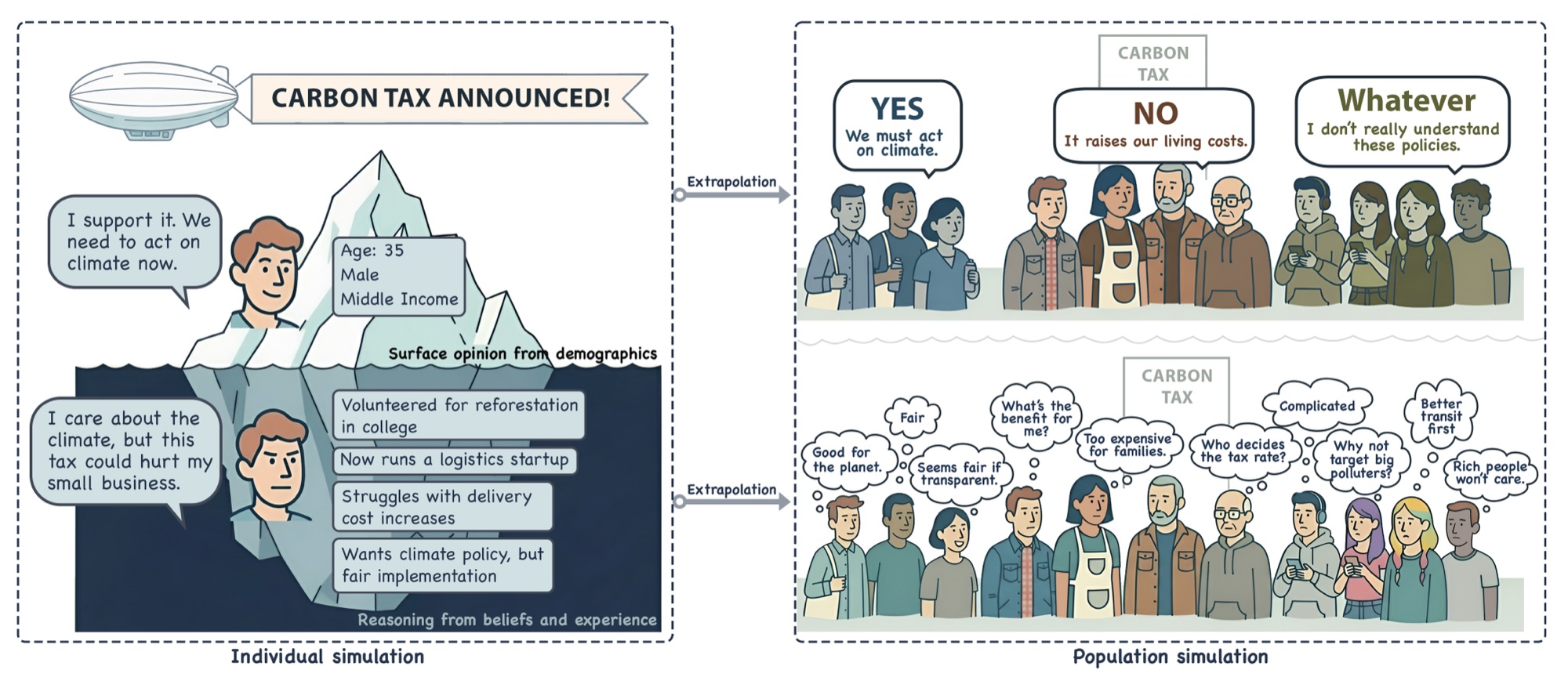
Much of today’s LLM social simulation is evaluated at the behavioral surface: demographic or persona information goes in, behavior comes out. Even when agents contain memory, reflection, or planning, the reasoning that connects a real person’s beliefs and experiences to behavior is rarely grounded, inspectable, or tested.
Behavioral agreement is not sufficient evidence of simulation fidelity. When the scientific question concerns belief formation, individual heterogeneity, or interventions, the same observed behavior can arise from different underlying mechanisms. An agent can give the right answer for the wrong reason. We should therefore validate not only what an agent says, but how its beliefs are formed and how they change.
That requires the same move psychology once made: from behaviorism to cognitivism.
So what should a simulation have in between?
“The ability to inspect how a belief or stance was formed through intermediate reasoning steps.” Without it, an agent’s reasoning trace is assembled after the fact from language patterns, with no belief model underneath.
“Simulations should preserve individual-level heterogeneity, the positional and contextual diversity of human reasoning.” Agents trained under shared priors collapse toward the mean of the pretraining distribution and erase it.
“The capacity to revise beliefs predictably in response to interventions or changes in context.” Most benchmarks test static inputs and never measure belief revision under a counterfactual: intervention blindness.
Together these define what the paper calls reasoning fidelity: a trace of belief formation that is traceable, revisable, and built from reusable causal parts. Two alignments make it precise.
The next section makes this concrete.
Three interview answers become causal motifs, the motifs compose into one person’s belief graph, and the graph is already an agent: ask it a survey question, change the world around it, and it answers as this person would. Start at step 3; steps 1 and 2 show where the agent came from.
Everyday language, elicited by a semi-structured interview. There is no survey scale yet and no persona label, just one person explaining their own view.
A motif is the smallest causal unit in someone’s reasoning: concept, signed arrow, concept. Each carries the sentence it came from, so every edge traces back to the person’s own words.
Drag the slider and watch the graph: support crosses the midline only after privacy concern falls below public safety. Every edge traces back to a sentence in step 1, so you can dispute one, change it, and rerun. A label cannot be argued with, only replaced.
Weights are illustrative; structure, sign, and strength of each edge come from the answers in step 1. do() sets the node’s value directly, so nothing flows upstream.t ∈ [−1, 1], status quo at t = 0Transparency T = 0.5 + 0.5 tPrivacy concern P = 0.7 − 0.4 t (t ≥ 0), 0.7 − 0.2 t (t < 0)Crime deterrence C = 0.2 + 0.6 t (t ≥ 0), 0.2 + 0.1 t (t < 0); Public safety S = COpposition O = 1.1 · P · (1 − 0.5 S), clipped to [0.05, 0.95]; Support = 1 − O; persona label = 0.23 + 0.03 t< 0.15 strongly oppose · < 0.27 oppose · < 0.45 lean against · < 0.60 torn · < 0.72 lean toward · < 0.85 support · else strongly supportSemantics: causal Bayesian network with the do-operator (Pearl, Causality, 2009); positive parents combine by noisy-OR, negative parents by noisy-AND-NOT (Cheng 1997; Griffiths & Tenenbaum 2005). The page uses a linear simplification of those rules.
Read further in the paper (PDF), sections 3.1 and 3.2.
The field is choosing, right now, between agents that sound human and agents that reason like humans. We argue for the second, and that takes two moves at once: the modeling paradigm and the evaluation paradigm both have to change. We propose one of each.
Interview a person, parse the answers into causal motifs, compose the motifs into a belief network, and run interventions on it. Symbolic structure keeps it interpretable; a language model does the elicitation and assembly. Weakly supported nodes stay visible.
A benchmark schema that scores the reasoning trace. Principles: traceability, demographic sensitivity, intervention coherence. Metrics: motif alignment, belief coherence, counterfactual robustness. Every item comes from a real interview.
Causal structure is the tractable place to start. People also reason by association, analogy, and feeling.
Accepted to the NeurIPS 2025 Position Paper Track.
@inproceedings{li2025simulating,
  title     = {Simulating Society Requires Simulating Thought},
  author    = {Li, Chance Jiajie and Wu, Jiayi and Mo, Zhenze and Qu, Ao
               and Tang, Yuhan and Zhao, Kaiya Ivy and Gan, Yulu and Fan, Jie
               and Yu, Jiangbo and Zhao, Jinhua and Liang, Paul Pu
               and Alonso, Luis and Larson, Kent},
  booktitle = {Advances in Neural Information Processing Systems (NeurIPS),
               Position Paper Track},
  year      = {2025},
  eprint    = {2506.06958},
  archivePrefix = {arXiv}
}